
Fair Value Gap Explained: What It Is and How Traders Use It in Real Markets
A fair value gap explains why price sometimes moves fast and later returns to the same area. It forms when price moves aggressively and skips proper order execution, creating an imbalance between buyers and sellers. This imbalance usually appears in a three-candle structure where the first and third candles do not overlap. Traders use this concept to understand where price is likely to react instead of guessing random reversals. A fair value gap trading strategy focuses on waiting for price to retrace into the gap after an impulsive move and then looking for confirmation, rather than chasing price. This approach helps traders trade with structure, patience, and clarity in real markets.
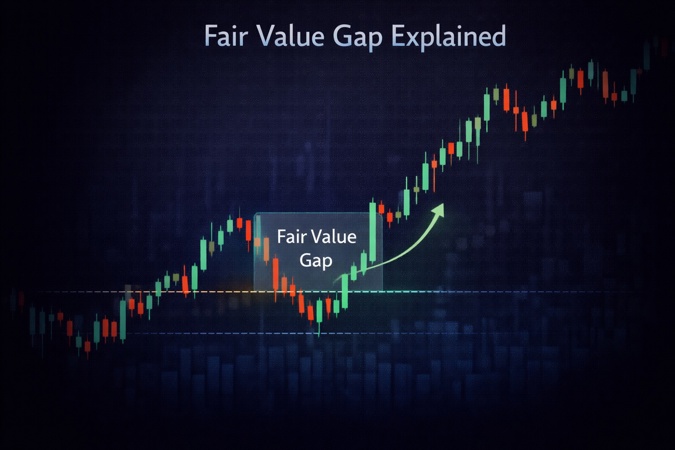

What is Fair Value Gap in Trading - A Trader’s Perspective
In trading, fair value simply means balance. When buyers and sellers are matched properly, price moves smoothly. A fair value gap forms when that balance breaks. Price moves aggressively in one direction and skips an area where orders never got filled. That skipped area is the imbalance.
This is not the same as a normal price gap. In crypto, forex, or even stocks, you often won’t see an empty space between candles. The imbalance exists inside the move itself. That’s what makes a fair value gap different.
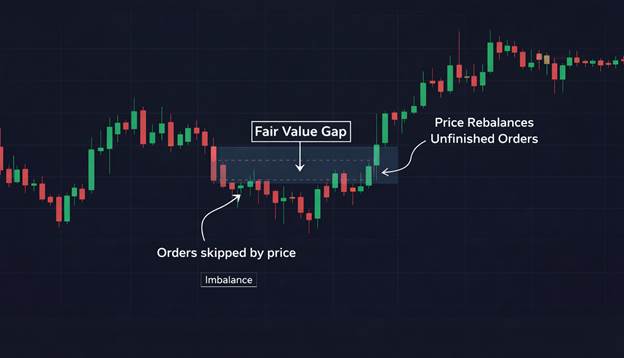
This chart shows a fair value gap created when price moves aggressively and skips proper trading in between. Buyers pushed prices so fast that sell orders inside the marked zone never got filled. That area becomes an imbalance. When momentum slows, price comes back into this zone to rebalance those unfinished orders. That is why price reacts inside the fair value gap instead of moving randomly.
What is the Problem Traders Usually Face Here
Most traders miss trades because they wait for obvious support or resistance. Price often reverses before those levels, leaving traders confused or chasing entries late. This happens because they are ignoring the fair value gap.
What a Trader Should Do - Practical Solution
Mark the fair value gap after a strong impulsive move. When price returns into that zone, wait for confirmation and look for entries inside the gap, not at random levels. Use structure and momentum for bias and place stops beyond the gap. Treat FVG as a reaction zone, not a prediction tool.
How to Identify Fair Value Gap on Any Chart Without Overthinking
Fair value gaps are three-candle patterns formed during strong, impulsive moves, where the first and third candles do not overlap. Focus only on clean price action, ignore indicators and avoid choppy markets.
How to identify a Bullish FVG
A bullish fair value gap forms after a strong upward move where three candles create a gap between the first candle’s high and the third candle’s low. Mark that zone and watch for price to return and react as support.
How to identify a Bearish FVG
A bearish fair value gap forms after a strong downward move where three candles create a gap between the first candle’s low and the third candle’s high. Mark that zone and watch for price to return and react as resistance.
The biggest mistake traders make is forcing fair value gap everywhere. Not every move creates a meaningful imbalance. Focus on clean, impulsive moves, not choppy price action.
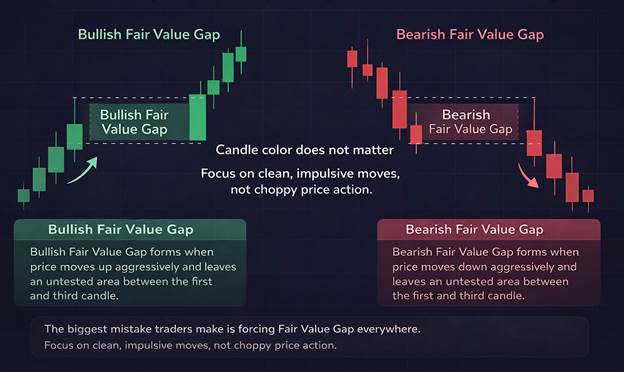
This image shows how to identify a fair value gap by spotting an aggressive price move that leaves an untested area between the first and third candle, whether bullish or bearish.The solution is ignore indicators, mark only clean impulsive moves and wait for price to return into the fair value gap instead of forcing trades in choppy price action.
Market Imbalance: What Breaks Price Efficiency in Live Markets
In an ideal world, price should move step by step, testing previous levels as it goes. But live markets are not ideal. Aggressive buying, aggressive selling, news and liquidity grabs all cause prices to move too fast.
When this happens, one side of the market dominates completely. Orders on the other side don’t get filled. This creates inefficiency. That inefficiency is the foundation of the fair value gap.
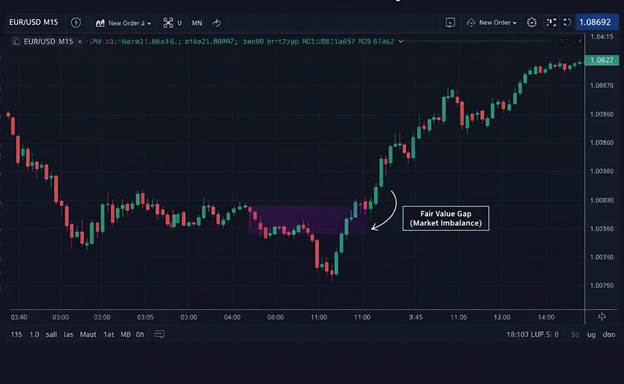
This chart shows aggressive one-sided buying where price moves too fast and skips levels. The shaded area marks the imbalance zone that price often revisits later to rebalance unfinished orders.
Fair Value Gap: Why Most Traders Don’t See What Price Is Really Doing
Most traders are trained to look only at support, resistance, indicators and patterns. None of those explain what happens between levels. That is why the price often looks random to them.
Fair Value Gap explains why price can reverse without touching a level and why it reacts sharply in the middle of a move. Traders miss it because it is not taught in basic technical analysis. Once you start seeing imbalance, those “random” moves stop looking random.
This is also why many traders say price does not respect technical analysis anymore. It does. They are just looking at incomplete information.
The Three-Candle Structure That Creates a Fair Value Gap
A fair value gap always forms using a three-candle structure. The first candle moves price in one direction. The second candle expands aggressively. The third candle continues without properly overlapping the first.
When the high of the first candle and the low of the third candle do not overlap, imbalance exists between them. That area is the fair value gap.
Balanced price action means candles overlap and test previous areas. Imbalanced price action skips those tests. fair value gap simply marks where that skip happened.
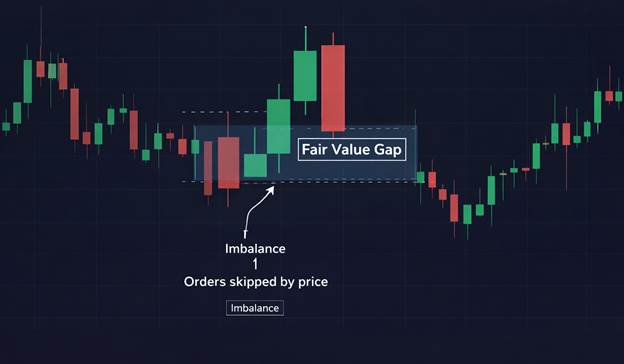
This image shows how a fair value gap forms through a three-candle structure where the middle candle moves price aggressively, causing the first and third candles not to overlap and leaving an imbalance where orders were skipped.
The solution for traders is to mark this fair value gap after the impulsive move and wait for price to return into the zone, then look for confirmation instead of chasing price, as reactions often occur where imbalance was created.
Why Price Returns to Fair Value Gaps And When It Doesn’t
Price often returns to fair value gaps because unfinished orders remain there. The market prefers balance. When volatility cools down, price comes back to rebalance.
However, not every fair value gap gets filled. Strong trends, heavy momentum, or fresh liquidity can keep prices moving without returning immediately. This is why blindly trading every gap is a mistake.
The real value comes from understanding context, not expecting guarantees.
Fair Value Gap as Support and Resistance in Live Trading
When price returns to a bullish fair value gap, that zone often acts as support. When price returns to a bearish fair value gap, it often acts as resistance.
This explains why price sometimes reverses before reaching an order block or a major level. The reaction happens earlier because imbalance is being resolved.
For active traders, this is extremely useful. It helps explain early reversals that otherwise look confusing.
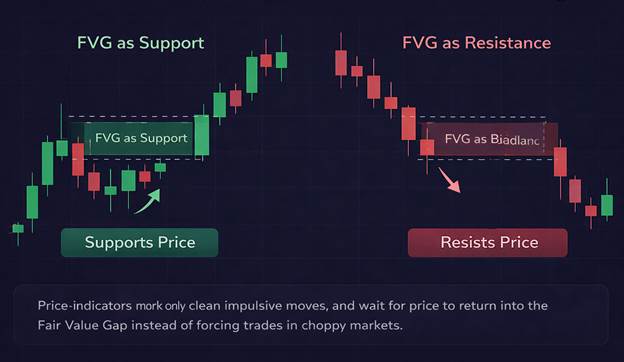
This image shows how a fair value gap acts as support in bullish moves and resistance in bearish moves. When price revisits the gap, it often reacts instead of moving straight through.
Fair Value Gap Trading Strategy: Entry Logic That Actually Works
Fair Value Gap is not about chasing price. It is about waiting.
Most traders fail because they want one perfect entry. Professionals think in zones. Some enter at the top of the gap, others wait for deeper fills near the middle. Scaling entries makes more sense than all-in execution.
If price respects the gap, reaction happens quickly. If it doesn’t, the idea is invalid. There is no need to overstay.
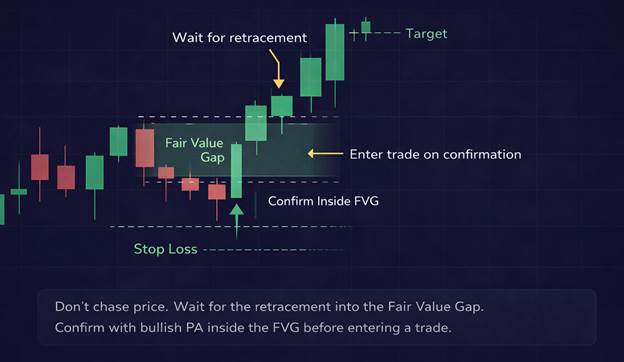
This image shows a practical fair value gap trading strategy where traders wait for price to retrace into the FVG after an impulsive move, enter only after confirmation inside the gap, place stop loss below the structure and target continuation with the trend.
Risk Management With Fair Value Gap: Stop Loss and Targets
Stop loss placement in fair value gap trading is not tight. It sits beyond the structure that created the gap. This protects you from wicks and volatility.
Yes, risk-reward often looks poor on paper. But probability improves. This is something experienced traders understand and beginners struggle to accept.
Targets are usually previous highs, lows, or liquidity areas. fair value gap is not about predicting huge moves. It is about high-clarity reactions.
How Fair Value Gap Fits Into a Complete Trading System Practically
Fair Value Gap is not a standalone system. It is a tool.
On its own, it shows imbalance. Combined with liquidity, structure and market context, it becomes powerful. Professionals use it to refine entries, not to replace everything else.
Over time, you stop asking why the price reversed early or why it ignored your level. You start seeing where imbalance exists and how price reacts to it. That is when trading becomes clearer and more controlled.
Final perspective
A fair value gap will not make you profitable overnight. Nothing does. But it will remove confusion. It will explain price behavior that most traders struggle with for years.
Practice it. Mark it on charts. Backtest it. See how price reacts the first time versus the second. Over time, it becomes less about finding trades and more about understanding price. That shift is where real progress happens.
FAQs
1. Does fair value gap work in all markets or only crypto?
Yes, fair value gap works in all markets including crypto, forex, indices and stocks. The concept is based on order imbalance, which exists in every liquid market.
2. Do all fair value gaps get filled by price?
No, not every fair value gap gets filled. Price often revisits gaps when momentum slows, but strong trends can continue without returning to rebalance.
3. Which timeframe is best for trading fair value gap?
Fair Value Gap appears on all timeframes. Higher timeframes provide stronger zones, while lower timeframes offer precise entries when aligned with the higher-timeframe bias.
4. Is the fair value gap better than support and resistance?
Fair Value Gap does not replace support and resistance. It explains why price reacts before reaching traditional levels, making it a powerful complement to structure-based trading.
5. What is the biggest mistake traders make with the fair value gap?
The biggest mistake is forcing fair value gaps in choppy markets. fair value gap works best after clean, impulsive moves, not during sideways price action.
Responses (0)
Leave a Reply
Your email address will not be published. Required fields are marked *
You might also like

Basics of Technical Analysis: A Beginner’s Guide to Reading Price, Charts and Candlesticks
Technical Analysis is the study of price charts to understand how buyers and sellers are behaving in the market. It is not about predicting prices or relying on indicators. Most beginners struggle not because charts are complex, but because they misinterpret what candlesticks, trends and patterns are actually showing. Technical analysis works across stocks, forex, crypto and commodities because human behavior drives all markets. This guide explains the basics of technical analysis in a clear, practical way, focusing on real price behavior, common beginner mistakes and how traders actually use charts to make informed decisions instead of guessing.

Market Trend Analysis Explained: Market Cycles, Accumulation and Distribution in Trading
Market trend analysis explains how price moves through structure, cycles and phases rather than predicting direction. Markets trend, pause, accumulate, distribute and repeat this process across all time frames. Trend analysis identifies whether price is making higher highs, lower lows, or compressing sideways, while market cycles explain why these structures form and reset. Accumulation and distribution occur inside consolidation, where institutions quietly build or exit positions before expansion or decline. When traders combine structural trend reading with market cycle awareness, they stop reacting to noise and start understanding where price is in the larger process.