
Trade with Support and Resistance in the Stock Market
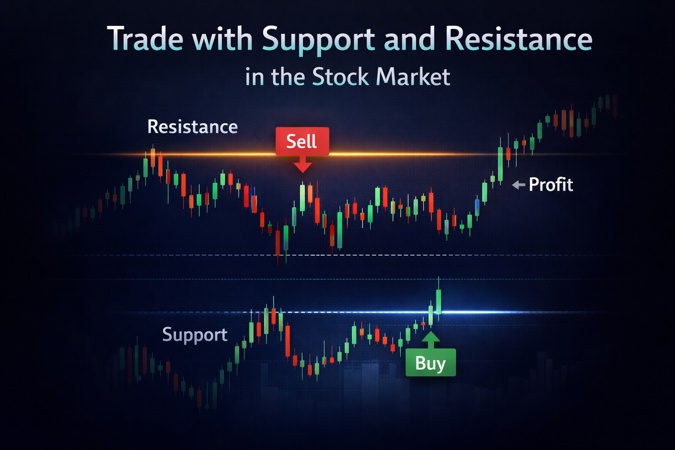
Support and resistance are price levels, not lines or guesses. Most traders struggle because they draw levels based on assumptions instead of objective price behavior. When you learn to identify support and resistance using candlestick data and higher timeframes, the market becomes clearer, calmer and more logical. This guide explains what support and resistance really are, why most traders fail and how to draw support and resistance correctly in a way that works across stocks, forex and indices.

Introduction
Most traders don’t lose money because they don’t know support and resistance. They lose money because they never learn which levels actually matter.
Almost every trader starts the same way. You learn support and resistance. You draw a few lines. Sometimes price reacts. Other times it moves straight through as if nothing existed. After enough of those moments, frustration quietly builds.
At some point, most traders think it but rarely say it out loud: support and resistance don’t work.
If that thought has crossed your mind, this blog is written for you. The issue is not that support and resistance are useless. The issue is that what most people learn under that name is not how support and resistance actually function in real markets. That gap between expectation and reality is where confusion begins.
What Is Support?
Support is a price level where buying interest previously became strong enough to slow or stop a decline.
Price does not stop because a line exists on your chart. It stops because real market participants decided that price was attractive enough to buy. That buying pressure creates memory. When price returns to the same area, attention increases again.
In simple terms, support is where price previously stopped falling because buyers stepped in.
What Is Resistance?
Resistance is a price level where selling pressure previously became strong enough to slow or stop a rise.
Just like support, resistance is created by real decisions. Sellers previously believed price was expensive or profitable to exit. That selling activity leaves behind a reference point. When price returns to that level, sellers often become active again.
In simple terms, resistance is where price previously stopped rising because sellers became active.
Why Support and Resistance Matter in Trading
Support and resistance matter because the market remembers price.
Traders remember where price reacted. Institutions remember where large orders were executed. Algorithms respond to historical levels. When price revisits those areas, participation naturally increases. That is why price reacts.
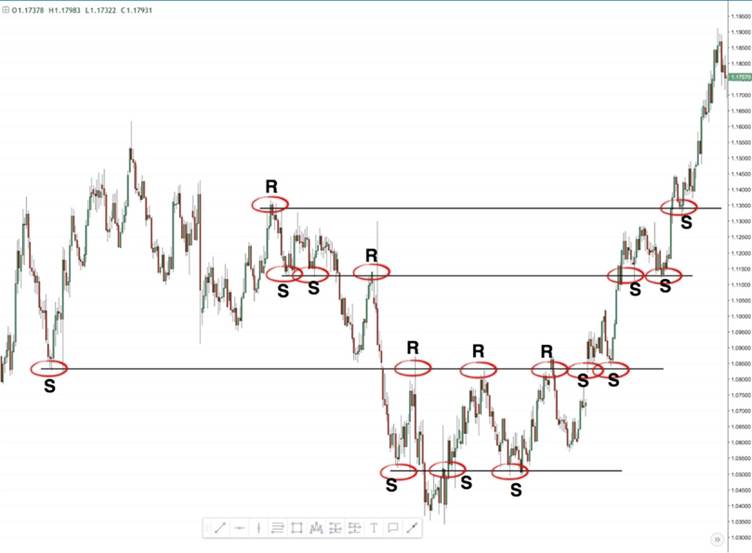
Example of how real market price repeatedly reacts at support and resistance levels
Why It Works for Institutions
Institutions do not chase price randomly. They operate around known price areas where liquidity exists. Support and resistance provide those areas. Large players build, reduce or defend positions around these levels because that is where volume previously existed.
Why It Often Fails for Retail Traders
Support and resistance usually fail for retail traders because they are taught how to draw levels, not how to read price.
Connecting two highs or lows feels logical at first. But when price starts moving in real time, uncertainty creeps in. The same chart produces different levels for different people, all of them looking reasonable and none of them consistent.
Markets do not respond to drawing styles. They respond to price.
This is where most beginners stop trusting their charts and start chasing indicators.
This is how understanding usually changes with experience.
“I used to think my support and resistance lines are the best and the market will respect it to the pip…”
— Trader reflection shared publicly on X
Support and Resistance Are Price Levels, Not Guesswork
Support and resistance are price levels, not predictions, drawings or assumptions.
When you draw levels based on what you think should happen, you are guessing. Markets do not work on assumptions. They work on objective price information that is visible to everyone.
Support and resistance only work when they are based on factual price data. Once subjectivity enters, consistency disappears.
Good levels feel obvious. If a level needs explanation, it usually doesn’t matter.
Candlestick Basics You Must Know
Before drawing any level, you must understand what the chart itself is showing.
Every candlestick contains only four pieces of information:
- Open price
- High price
- Low price
- Close price
Nothing more.
The body shows the distance between open and close. The wicks show where price attempted to move but failed to sustain.
A daily candle represents one full day of decisions. A weekly candle represents an entire week of acceptance and rejection.
Support and resistance are built from this price information, not from visual tricks.
How to Identify Support and Resistance Correctly
This is the part most traders rush and the part that changes everything.
Start with a higher timeframe. Begin with the daily or weekly chart, even if you trade intraday. Higher timeframes show levels that matter to the broader market.
Focus on factual price levels. Use open, high, low and close prices. These are recorded by the exchange and identical for everyone.
Let price confirm the level. Real levels show multiple reactions, clear rejection or acceptance and respect over time.
Reduce, do not add. If your chart looks crowded, your thinking will be unclear. Fewer well-understood levels lead to better decisions.
Strong vs Weak Levels
Strong levels come from higher timeframes, show multiple reactions and clear rejection. Weak levels exist only on lower timeframes and often show random movement.
Strong levels attract attention. Weak levels create noise.
Using Support and Resistance in Real Trades and Option Trading

Support and resistance trading is not about entries. It is about context.
Bounce trades rely on rejection, not touch. Breakout trades rely on acceptance, not speed. Role reversal shows trapped traders adjusting positions.
Levels guide attention. Price behavior provides answers.
Market Behavior and Trading Insight
|
Market Behavior |
What to Observe |
Trading Insight |
|
Price rejects support |
Long wicks and strong closes |
Buyers defending the level |
|
Price accepts resistance |
Strong closes above the level |
Breakout acceptance |
|
False breakout |
Quick move beyond the level then return |
Liquidity grab |
|
No reaction at level |
Flat or slow movement |
No trade scenario |
False breakouts are not random. Many traders place stops at obvious levels. Price often moves just far enough to trigger those stops before returning. This is liquidity, not manipulation.
If price shows no clear reaction at a level, the correct trade is often no trade.
Final Perspective
Support and resistance are not broken concepts. They are misunderstood concepts.
When you stop assuming and start observing, when you focus on objective price instead of personal drawings, the market begins to make sense.
You do not need more indicators.
You do not need more strategies.
You need clarity.
Clarity in trading usually comes from removing assumptions, not adding tools. That is how support and resistance in the stock market are meant to be used.
FAQs
1. What is support and resistance in simple words?
Support and resistance are price levels where the market has reacted before. Support is where price previously stopped falling and resistance is where price previously stopped rising. These levels matter because traders remember price.
2. Why does support and resistance fail for beginners?
Support and resistance usually fail when levels are drawn based on guesswork instead of objective price data and higher timeframes. This creates inconsistency and loss of confidence.
3. How do I identify support and resistance correctly?
Start with a daily or weekly chart and focus on clear price reactions using open, high, low and close prices. Levels that are visible without forcing usually matter more.
4. Are support and resistance indicators reliable?
Support and resistance indicators can highlight areas of interest, but they cannot read market context or intent. Price behavior provides clearer information.
5. Which timeframe is best for support and resistance?
Daily and weekly charts produce stronger and more reliable support and resistance levels because they reflect broader market participation.
Responses (0)
Leave a Reply
Your email address will not be published. Required fields are marked *
You might also like

Basics of Technical Analysis: A Beginner’s Guide to Reading Price, Charts and Candlesticks
Technical Analysis is the study of price charts to understand how buyers and sellers are behaving in the market. It is not about predicting prices or relying on indicators. Most beginners struggle not because charts are complex, but because they misinterpret what candlesticks, trends and patterns are actually showing. Technical analysis works across stocks, forex, crypto and commodities because human behavior drives all markets. This guide explains the basics of technical analysis in a clear, practical way, focusing on real price behavior, common beginner mistakes and how traders actually use charts to make informed decisions instead of guessing.

Market Trend Analysis Explained: Market Cycles, Accumulation and Distribution in Trading
Market trend analysis explains how price moves through structure, cycles and phases rather than predicting direction. Markets trend, pause, accumulate, distribute and repeat this process across all time frames. Trend analysis identifies whether price is making higher highs, lower lows, or compressing sideways, while market cycles explain why these structures form and reset. Accumulation and distribution occur inside consolidation, where institutions quietly build or exit positions before expansion or decline. When traders combine structural trend reading with market cycle awareness, they stop reacting to noise and start understanding where price is in the larger process.