
Futures and Options Explained: A Beginner's Guide to F&O Trading in India
This guide explains Futures and Options (F&O) trading in a simple and structured way for beginners. It starts with the basics of derivatives and works its way up to futures and options, explaining terms like leverage, premium, and lot sizes along the way. It shows how profits and losses operate in F&O trading and the risks that come with it by giving real-life examples. The blog also talks about typical blunders, trading psychology, and risk management rules. This helps readers learn how to approach F&O with clear thinking and discipline instead of guesswork.

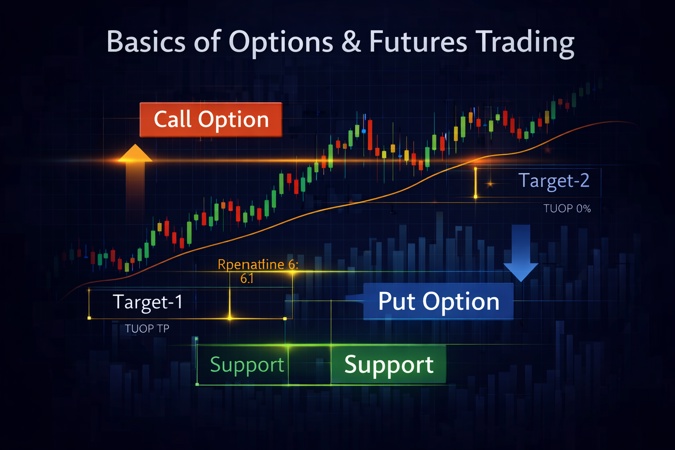

Futures and Options Explained: A Beginner's Guide to F&O Trading in India
Most traders enter futures and options because they think they can make money quickly. Many traders fail to understand the underlying mechanics of these tools. If you don't know how they work, the risks, or the reasoning behind them, trading is just an expensive guess.
This guide starts with the basics of F&O, explaining what derivatives are and then going through futures and options step by step. It ends with the risk realities that most beginners find out about too late.
In India, Futures and Options (F&O) are traded on exchanges like NSE and BSE under SEBI regulation, and are widely used by retail traders for speculation and hedging.
What Are Derivatives? The Foundation You Must Understand
A derivative is a type of financial instrument whose value comes from an underlying asset, like a stock, index, commodity, or currency. There is no value in the contract itself. The price of it depends on what it stands for.
Let’s understand with a simple example to help you grasp the concept.
A simple house in a normal neighborhood might cost ₹50 lakh. The price of the same house can go up a lot if it is in a good location like near some celibrity's house. The structure is still the same, but its value is now based on where it is.
Derivatives work in the same manner. The value of these things doesn't come from the contract itself; it comes from how the underlying asset moves.
The Four Types of Derivatives
There are four types of derivatives around the world: forwards, futures, options, and swaps. F&O stands for futures and options, which are the two types of stocks that are most often traded in the Indian stock market. This blog is mostly about these two.
Forward Contracts
You need to know what forward contracts are before you can grasp futures. This is because futures came from forward contracts.
How a Forward Contract Works
A forward contract is a private agreement between two people to buy or sell something at a specified price on a set date in the future. There is no trade. There is no regulator in charge of it.
Example: A food processing company agrees with a wheat supplier to purchase wheat after two months at ₹25 per kg.
-
If prices rise → company benefits
-
If prices fall → supplier benefits
Both sides remove price uncertainty.
The Problem with Forwards
There is no exchange or regulator; therefore, either party can default. If the market goes sharply against one side, they might just not follow through on the agreement. Counterparty risk is the chance that one party won't deliver, and it's the main problem that futures contracts were meant to fix.
Futures Contracts — Forwards Made Safer
It is like a forward contract in that it is a legally binding agreement to purchase or sell something at a set price on a set date in the future. However, it is exchanged on a controlled exchange that makes sure both parties will keep their end of the deal. The exchange takes away all counterparty risk by acting as an intermediary and enforcing margin requirements.
In India, F&O trading is regulated by SEBI to ensure transparency, margin discipline, and exchange-level safety for all participants.
Types of Futures Contracts
Futures are categorized based on the underlying asset:
-
Stock Futures (Example: Reliance, TCS)
-
Index Futures (Example: Nifty 50, Bank Nifty, Sensex)
-
Commodity Futures (Example: Gold, Silver, Crude Oil)
-
Currency Futures (Example: USD/INR)
How Futures Differ from Forwards
The main distinction is that there is a third party that is regulated. When you make a forward, it's just you and the other person. The exchange, like NSE, acts as a middleman and guarantees the futures contract. The exchange steps in if one side doesn't follow through. The exchange also sets the standard for the contract: the lot sizes, expiration dates, and settlement terms are all defined by the exchange, not by private negotiations.
Example
A manufacturing company agrees today to buy raw material after one month at a fixed price through an exchange.
-
If market price rises → company benefits
-
If it falls → company still pays the agreed price
The contract is binding in all cases.
Lot Sizes and Margin Requirements
You can't buy just one share with a futures contract. Lot sizes in India are fixed by NSE and vary from stock to stock. For example, one lot of TCS or Reliance represents a specific number of shares defined by the exchange. Lot sizes are usually set so that the total value of the contract is between ₹2.5 lakh and ₹8 lakh, depending on the stock.
You also don't pay the full lot value up front. Instead, you put down a portion of the whole contract value, usually between 10% and 20%. This is what brings in leverage, which is discussed below.
How Futures Are Priced
Futures contracts usually cost a little more than the current market price of the stock they are based on. If a company's stock is at ₹500 today, the one-month futures contract can be worth ₹505 or ₹495.There isn't much difference because futures prices are quite close to the actual market price, with tiny changes for time and carrying costs.
Most traders don't keep contracts until they expire. They exchange the contract itself before it expires to make money or cut losses without ever physically delivering shares.
Options Contracts - The Right Without the Obligation
It lets the buyer buy or sell an asset at a predetermined price, called the strike price, before or on a certain date. The buyer gets the right but not the obligation. The buyer pays a cost called the premium to acquire this right, and that fee is not refundable.
Call Options Explained
A call option lets the buyer buy an item at the strike price before the option expires. It is used when you expect prices to rise.
Example
A retailer expects the price of a product to rise. He pays ₹5 per unit today to lock the purchase price at ₹100 for the next month.
-
If price rises to ₹120 → he buys at ₹100 and profits
-
If price falls to ₹90 → he does not buy
Loss = ₹5 (premium)
Put Options Explained
A put option lets the buyer sell an asset at the strike price before the option expires.
Example
A trader holds goods and pays ₹4 per unit to secure the right to sell at ₹80.
-
If price falls to ₹60 → he sells at ₹80
-
If price rises → he ignores the option
Loss = ₹4 (premium)
What Is a Premium?
The premium is the amount of money that the buyer pays to get the rights to an options contract. You can't get your money back, no matter what you do with the option.
Let's look at a full example to grasp this.
The spot price (the current price of Reliance) is ₹2,100.
Price of the strike: ₹2,150
Premium = ₹20 for each share
Lot size = 1,000 shares
Total premium paid: ₹20 × 1,000 = ₹20,000
You have put in a total of ₹20,000.
Scenario 1: The price goes up.
If Reliance goes up to ₹2,300:
You may get it for ₹2,150.
Price on the market: ₹2,300
Profit for each share is ₹150.
Net profit = ₹150 – ₹20 = ₹130 per share. Total profit = ₹130 × 1,000 = ₹1,30,000.
Scenario 2: The price stays the same
If Reliance stays below ₹2,150:
You won't utilize the option
Because it doesn't make sense to buy at ₹2,150
Your total loss is ₹20,000 (the premium you paid).
Important Insight:
The premium tells you how much you can lose.
You can't lose more than ₹20,000, no matter how much the market goes down.
Futures vs. Options- A Clear Comparison
|
Feature |
Futures |
Options |
|
Obligation |
Binding for both sides |
Only for the seller |
|
Cost to enter |
Margin deposit |
Premium paid |
|
Maximum loss (buyer) |
Theoretically unlimited |
Limited to premium |
|
Flexibility |
Must settle or exit before expiry |
Can let expire without penalty |
|
Risk level |
Very high |
High, but capped for buyer |
The Leverage Effect - Why F&O Attracts and Traps Traders
With leverage, you may manage a big position by putting down only a small amount of its worth. The complete position, not simply what you put in, is used to figure out gains and losses.
How Leverage Magnifies Profits
Leverage allows you to control a large position with a small amount of capital. Profits are calculated on the full position value, not just the margin you deposit.
Example
MRF shares are trading at ₹60,000.
If you buy 1 share in the cash market:
-
Investment = ₹60,000
-
Price rises to ₹70,000
-
Profit = ₹10,000
-
Return = 16.7%
Now look at the futures position.
One lot = 10 shares
Total value = ₹6,00,000
You don’t pay ₹6,00,000. You deposit margin of ₹60,000 (10%).
If price rises to ₹70,000:
-
Profit per share = ₹10,000
-
Total profit = ₹1,00,000
You invested ₹60,000 and made ₹1,00,000
Return = 166%
This is leverage working in your favor.
How Leverage Magnifies Losses
The same leverage works against you when the trade goes wrong.
Example
MRF falls from ₹60,000 to ₹50,000.
If you own 1 share:
-
Loss = ₹10,000
In futures (10 shares):
-
Loss per share = ₹10,000
-
Total loss = ₹1,00,000
You only deposited ₹60,000
But your loss = ₹1,00,000
Result
The broker sends out a margin call right away, which is a request for more money or a threat to sell the account at a loss. Futures can and often do lose more money than the initial investment. Furthermore, since the leveraged amount is borrowed money, brokers charge interest on it every day. This is a cost that builds up for the trader whether the deal wins or fails.
Common Mistakes Beginners Make in F&O
The worst thing you can do is treat F&O like a lottery. Setting your position sizes based on how much money you want to make instead of how much you can afford to lose goes against the whole idea of risk management.
The second mistake is not taking lot sizes seriously. A ₹20,000 premium can mean a position worth ₹5 lakh or more in notional exposure. Beginners often forget this until they get a margin call.
Ignoring time decay loses option buyers money every day as expiration gets closer, even if the stock price doesn't move.
When you enter futures without a stop-loss, the market decides when to exit, which is always at the worst time.
Trading Psychology and F&O
F&O sets up a certain kind of mental trap. A big emotional reaction happens when a trader wins early using leverage, and they start pursuing that feeling instead of following a procedure. The sizes of the positions grow. There is no more discipline.
Before initiating each position, every structured trader asks himself, "What is my maximum loss if the trade goes wrong, and can I really handle it?" Not "how much can I make," but "how much can I lose?" If the answer makes you feel uncomfortable the position is too big.
Risk Management in F&O Trading
Three rules that you can't break: Don't put more than 1–2% of your total capital at risk on a single transaction; always establish a stop-loss before you enter, not after the position moves; and always know the actual notional value of the position, not just the margin you put down.
You have to paper trade for two to three months before putting real money at risk. This is the only way to learn how contracts act during earnings events, volatile sessions, and expiration weeks without losing real money.
Conclusion
Futures and options are useful for hedging risk, managing price exposure, and allowing organized market participation. But they require a level of awareness and discipline that most novices don't realize they need.
Before you look at the charts, learn how they work. Know how leverage affects your capital in both directions. Before you go on a position, decide how much you are willing to lose at most. Don't wait until it goes against you.
Always put survival above growth while trading. The traders who last are the ones who lose slowly enough to keep learning.
FAQs
1. Is F&O trading allowed in India for beginners?
Yes, F&O trading is allowed in India on NSE and BSE, but beginners must understand risks and margin requirements before trading.
Responses (0)
Leave a Reply
Your email address will not be published. Required fields are marked *
You might also like

Multiple Time Frame Analysis: A Practical Swing Trading Framework
This swing trading strategy is designed for traders who struggle with timing, not ideas. Most losses don’t come from missing opportunities, but from acting during the wrong phase of the market. This framework uses multiple time frame analysis to separate planning, confirmation, and execution into distinct steps, removing emotional decision-making during live markets.
Top 3 Chart Patterns in Trading You Must Know as a Beginner
Are trading charts going over your head? Then look no further - This guide will break down the top essential chart patterns in trading, signal market movements, practical strategies, risk management, and common mistakes to avoid as a beginner.