
How to Enter a Trade: High-Probability Entry Strategy (Price Action + SMC)
The best way to enter a trade is not about finding new indicators. It is about executing a structured process. A high-probability trade entry depends on three conditions: high timeframe level, liquidity behavior, and structural confirmation. Price must be near an HTF level. Liquidity must be taken or targeted. Structure must confirm intent through BMS or SMS. Without these, entries become random.


The 3 Non-Negotiable Conditions Before Any Entry
Most traders fail because they focus on tools before context. A real trade entry strategy begins only after three conditions are satisfied.
First, the price must be near a marked high timeframe level.
Second, liquidity must either be absorbed or clearly targeted. To understand this deeper, see our guide on liquidity in trading.
Third, confirmation must appear through a break of structure.
If any one of these is missing, entry should be avoided.
This is where confusion begins. Traders react to candles instead of waiting for structure. Entry works only when the market has already shown intent.
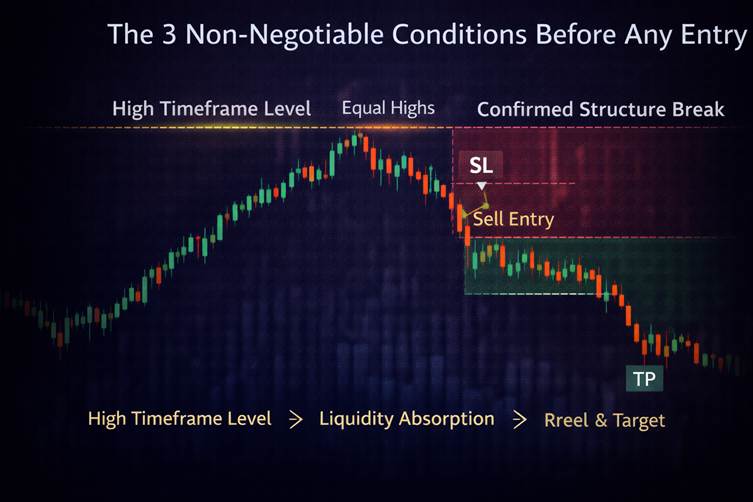
This chart shows price reacting at a high timeframe level, liquidity being swept through equal highs and a clear break of structure forming afterward. The visual explains that entry should only occur after HTF context, liquidity absorption and structural confirmation align.
High Timeframe Level First: The Foundation of Multi Timeframe Entry Strategy
A proper multi timeframe entry strategy always begins from HTF and drills down. Lower timeframe setups look clean, but without higher timeframe alignment, they fail more often than traders admit.
High timeframe defines direction and liquidity objective. Lower timeframe only refines execution. When traders reverse this order, they get trapped in noise and false signals.
The first filter in any trade entry strategy is simple: if price is not near a meaningful HTF level, do not plan an entry.
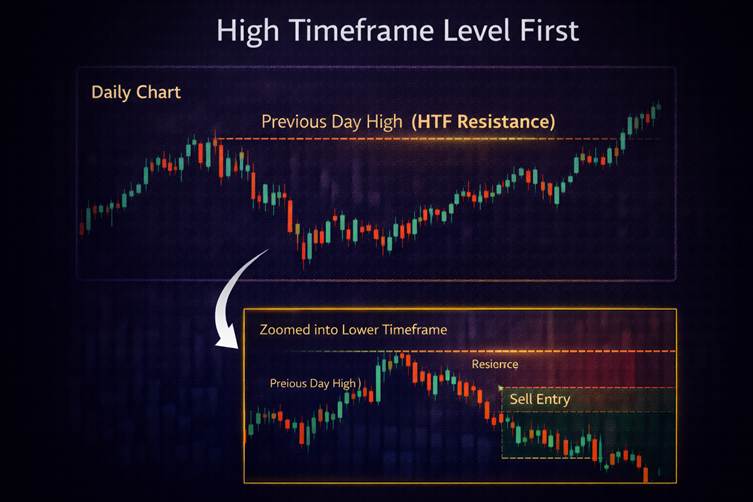
The image displays a daily chart with a marked HTF resistance level and a zoomed lower timeframe section below it. Price reacts at the higher timeframe level and the lower timeframe shows refined entry confirmation, demonstrating multi timeframe entry logic.
Liquidity Absorption and Direction Clarity Before Entry Confirmation in Trading
Liquidity tells you whether the market has finished hunting orders.
Before planning a high probability trade entry, one of two things must be clear:
Liquidity has already been swept.
Or it is obvious which liquidity pool price is targeting next.
If neither is clear, skip the trade.
Many traders confuse wick reactions for confirmation. A wick is not entry confirmation in trading. Liquidity sweep followed by structure shift is.
Direction must be logically explained before execution begins.
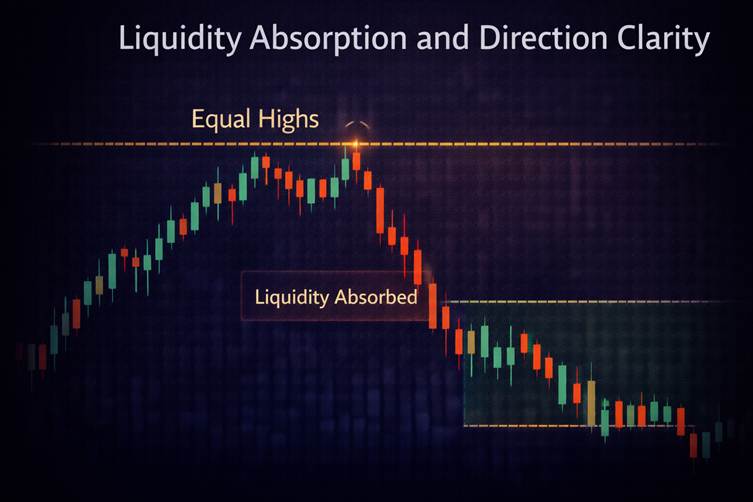
This chart highlights equal highs acting as liquidity. Price sweeps above the equal highs, absorbs liquidity and then reverses sharply, a concept also used in the three drive pattern strategy. The reaction after the sweep confirms that liquidity has been taken and directional clarity has formed.
Break of Structure (BMS vs SMS): High Probability Trade Entry Filter
Confirmation comes through structure.
If a clean BMS forms after liquidity absorption, probability is high.
If SMS forms, probability is moderate.
If neither forms, no entry should be taken.
Not every breakout entry strategy carries equal weight. Structure inside liquidity context creates a valid entry setup, not random breakout candles.
Risk sizing should reflect structure quality. Strong BMS allows stronger conviction. Mixed signals require moderated risk.
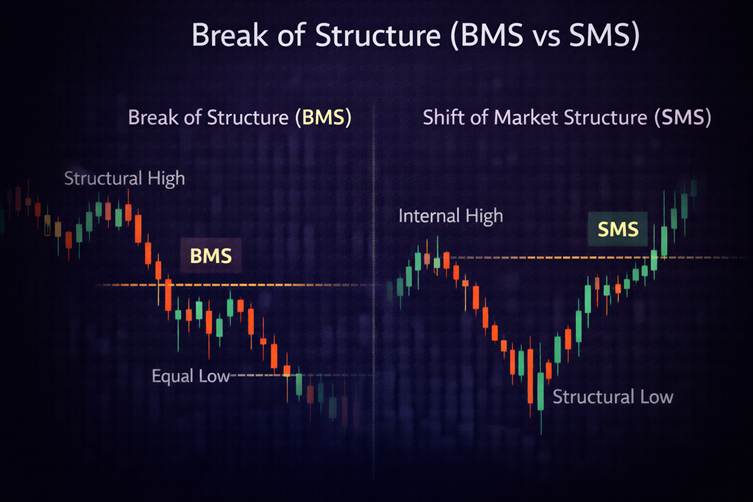
The image compares a strong Break of Market Structure with a weaker Shift in Market Structure. One section shows a major structural high being broken, while another shows an internal structure shift, helping traders distinguish confirmation strength.
Best Entry Strategy in Trading Using Premium and Discount Zones
The simplest price action entry strategy is premium and discount.
Once confirmation appears, mark the last impulsive leg and divide it into premium and discount. In bullish structure, buy at a discount. In bearish structure, sell at a premium.
This is the best entry strategy in trading for traders who want clarity without complexity. Price cheap means buy. Price is expensive means to sell.
But one rule must remain clear: if price reaches HTF target before retracement, no trade is taken. Wait for the next swing and redefine the leg. Never force an entry.
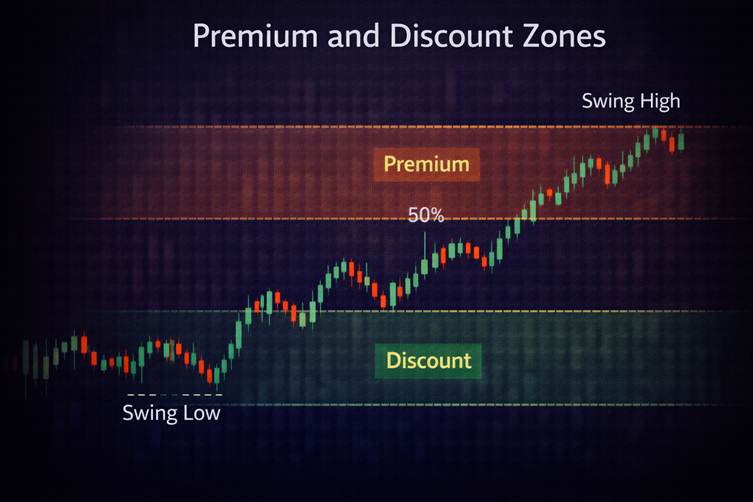
The chart marks a swing low and swing high, dividing the range at the 50 percent level. The upper half is labeled premium and the lower half discount, visually explaining where buying or selling is statistically favorable.
Fibonacci Golden Zone Entry: Improving Risk–Reward in Price Action Entry Strategy
Premium-discount gives base logic. Fibonacci refines execution.
Instead of entering at 50 percent, traders can refine entries into the golden zone. This improves timing entry in trading and enhances reward without changing narrative.
Dynamic adjustment is critical. If price does not retrace and creates a new swing high, move the Fibonacci to the updated leg. Do not enter late. Let structure redefine opportunity.
Target remains HTF liquidity. Entry precision changes, not direction.
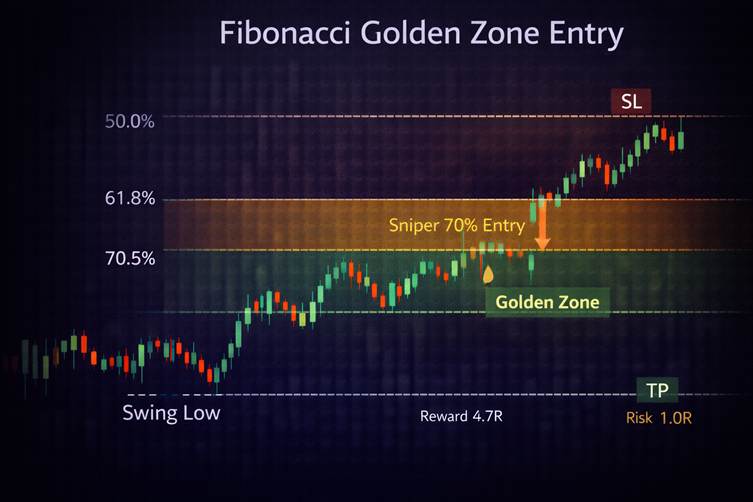
This image shows a Fibonacci retracement drawn from swing low to swing high. The golden zone between 61.8 and 70.5 percent is highlighted, with a refined entry inside the zone and a clearly defined risk to reward projection.
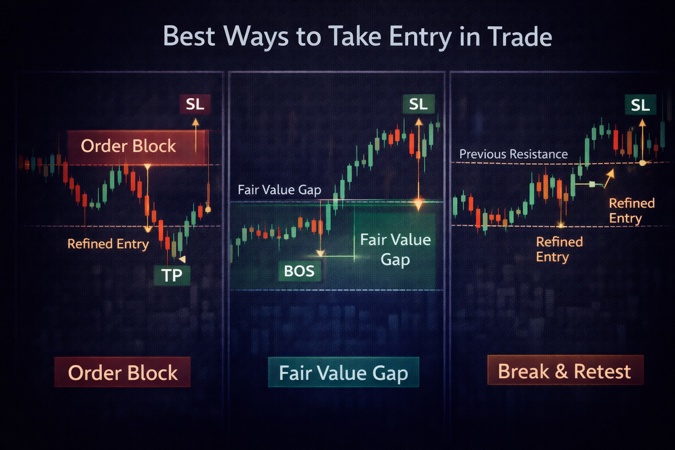
Using Fair Value Gap, Order Block and Breaker Block for High Probability Trade Entry
After confirmation and zone marking, inefficiencies refine the entry further.
Inside discount or premium, locate fair value gap, order block, or breaker block. These zones reduce stop distance and improve reward.
This deepens the same trade entry strategy, it does not change it. Risk tightens. Reward expands.
Some traders perform better with FVG, others with breakers. Practice reveals which inefficiency works best per instrument. Refine based on data, not preference.
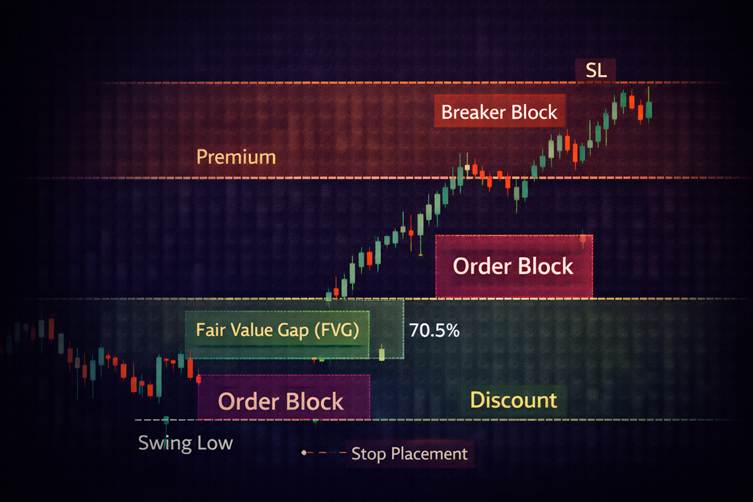
The chart shows a discount zone containing a fair value gap and an order block. A breaker block forms after structure shifts. Stop placement is marked below structure, showing how inefficiencies refine high probability trade entries.
Entry Without Indicators vs Indicator-Based Confirmation After Liquidity Setup
Entry without indicators works when liquidity and structure are clear.
Indicators can assist after confirmation. They should never decide direction. An indicator-based breakout entry strategy fails when used before structure confirms.
Once liquidity is absorbed and structure shifts, indicator triggers become execution tools. Before that, they are noisy.
Execution must follow context.
Risk–Reward Rules and Stop Loss Placement for How to Enter a Trade Correctly
Risk must align with invalidation, not emotion.
Stop loss belongs below liquidity that should not be revisited. Target belongs to the next HTF liquidity pool. Targets must come from a higher timeframe, not random RR multiples.
If the reward is below 1:1, skip.
If above 1:1, consider.
Golden zone improves RR.
FVG and the breaker improve it further.
Understanding how to enter a trade correctly means executing with defined invalidation and predefined liquidity objectives.
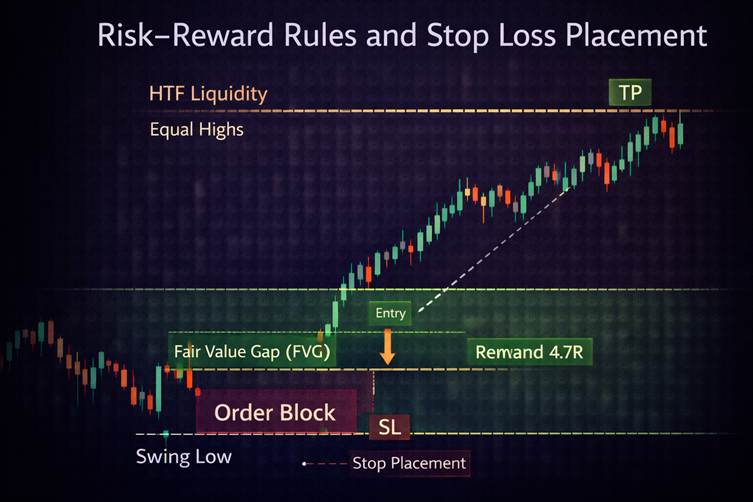
This image demonstrates entry near a refined zone, stop loss placed below liquidity and structure and target set at higher timeframe liquidity. A visible risk to reward projection confirms alignment with predefined invalidation and objective.
Best Ways to Take Entry in Trade: Chart Selection and Watchlist Filtering Framework
Most traders lose not because of bad entries, but because of poor selection.
Out of ten charts, maybe one shows:
Clear HTF level.
Clear liquidity absorption or objective.
Clear structural confirmation.
That chart becomes the focus.
This filtering framework strengthens any forex trade entry strategy, stock setup, or crypto model because it removes randomness from selection.
Professional trading is selection first, execution second.
FAQs
1. What is the best entry strategy in trading?
A high-probability entry combines high timeframe levels, liquidity sweep or target, and structure confirmation. Entries are then refined using zones like premium/discount or FVG.
2. How do you confirm a trade entry?
Confirmation comes after liquidity is taken and a break of structure (BMS) or shift in market structure (SMS) forms. Without this, entries are unreliable.
3. What timeframe is best for entry?
Higher timeframes define direction, while lower timeframes are used for precise entries. The best entries always align with higher timeframe bias.
Conclusion
The best trade entries are not found—they are built through structure, liquidity, and discipline.
When high timeframe context, liquidity behavior, and confirmation align, execution becomes mechanical.
Without this alignment, trading becomes guessing.
Responses (0)
Leave a Reply
Your email address will not be published. Required fields are marked *
You might also like

Multiple Time Frame Analysis: A Practical Swing Trading Framework
This swing trading strategy is designed for traders who struggle with timing, not ideas. Most losses don’t come from missing opportunities, but from acting during the wrong phase of the market. This framework uses multiple time frame analysis to separate planning, confirmation, and execution into distinct steps, removing emotional decision-making during live markets.
Top 3 Chart Patterns in Trading You Must Know as a Beginner
Are trading charts going over your head? Then look no further - This guide will break down the top essential chart patterns in trading, signal market movements, practical strategies, risk management, and common mistakes to avoid as a beginner.