
Options Greeks Explained: Delta, Theta, Gamma, Vega Guide
You bought a contract for options. The stock went in the direction you wanted it to. But your premium still went down. Most beginners go through this, and the reason is always the same: they traded without fully comprehending option greeks. Greeks are not hard ideas. They are the rules that all options must follow when they act. This article explains how options are priced, what each Greek measures, and how to apply them in real life. This is options trading for beginners in India that traders can use before they make their next trade.


What Are Options? A Quick Base
A call option entitles to acquire an asset at a defined price. You can sell with a put option. Options have an expiration date, a strike price (ATM, ITM, OTM), and a premium that changes all the time, even when the price of an underlying asset doesn't change. Greeks explain that difference between what you expect and what actually happens.
Important Terms You Need to Know First
The spot price is the price of the underlying asset on the market right now. This is how we figure out how much each option is worth.
The strike price is the price set in the contract at which you can buy or sell. Exchanges set these values at regular intervals.
Strike prices are mainly categorized into three types:
-
ATM (At The Money) means that the strike price is equal to or very close to the current spot price.
-
ITM (In The Money) means a strike that already has value.
-
OTM (Out of The Money) means that the strike doesn't be valued yet.
Example:
Lets suppose a stock ABC is trading at a price of ₹1000.
| Call Option Category |
Call Option Premium (Approx.) |
Strike Price |
Put Option Premium (Approx.) |
Put Option Category |
|---|---|---|---|---|
| ITM | 60 | 950 | 6 | OTM |
|
ITM |
37 | 975 | 10 | OTM |
|
ATM |
15 | 1000 | 15 | ATM |
|
OTM |
10 | 1025 | 37 | ITM |
| OTM | 6 | 1050 | 60 | ITM |
Kindly note that the premium values are not exactly calculated, but it will similar when you actually look at option chain of any stock or index.
Here, as you can see, the option pricings are different based on their respective strike prices. Options that are more in-the-money (ITM) have higher values, while out-of-the-money (OTM) options are pricing lower.
These option strike prices do not remain in the same category for a lifetime. As the spot price changes during the session, these categories change as well.
The option premium is the amount of money you pay to buy the contract. No matter what happens, it can't be returned. It is the price of being able to take part in the trade.
Unlike stocks, you cannot buy random quantities of options. They come in predefined bundle size called lot sizes. For example, a premium of ₹15 per unit on a 500-unit lot means ₹7,500 of actual money is at risk. Always consider the total lot exposure, not just the per unit premium.
How Option Pricing Works
Option Price = Intrinsic Value + Time Value
OR
Option Price = Actual Value + Hype Value/Premium
The intrinsic value of an option is the amount by which the option is in-the-money (ITM).
General formula:
Call option:
Intrinsic Value = Spot Price − Strike Price (if value is -ve, = 0)
Put option:
Intrinsic Value = Strike Price − Spot Price (if value is -ve, = 0)
Intrinsic value can never be less than zero. If the formula returns a negative number, the intrinsic value is zero.
The time value of an option is the extra amount that traders pay beyond the intrinsic value, which is based only on what the market expectations are and how much time is left.
General formula (Same for both Call and Put option):
Time Value = Option Premium - Intrinsic Value
Example:
Lets suppose a stock ABC is trading at a price of ₹1000.
The following chart illustrates the calculation for call option.
| Call Option Category |
Call Option Premium (Approx.) |
Strike Price |
Intrinsic Value (Spot Price - Strike Price)
|
Time Value (Option Value - Intrinsic Value) |
|---|---|---|---|---|
| ITM | 60 | 950 |
50 |
10 |
|
ITM |
37 | 975 | 25 | 12 |
|
ATM |
15 | 1000 | 0 | 15 |
|
OTM |
10 | 1025 | 0 | 10 |
| OTM | 6 | 1050 | 0 | 6 |
The following chart illustrates the calculation for put option.
| Put Option Category |
Put Option Premium (Approx.) |
Strike Price |
Intrinsic Value (Strike Price - Spot Price) |
Time Value (Option Value - Intrinsic Value) |
|---|---|---|---|---|
| OTM | 6 | 950 |
0 |
6 |
|
OTM |
10 | 975 | 0 | 10 |
|
ATM |
15 | 1000 | 0 | 15 |
|
ITM |
37 | 1025 | 25 | 12 |
| ITM | 60 | 1050 | 50 | 10 |
When the time value runs out, it goes to zero. An OTM option that has no inherent value and no time value left expires utterly worthless. This is exactly why the risk of OTM options expiry crushes most newbies.
What Are Option Greeks?
Option Greeks are numbers that show how the price, time, and volatility of an option affect its premium.
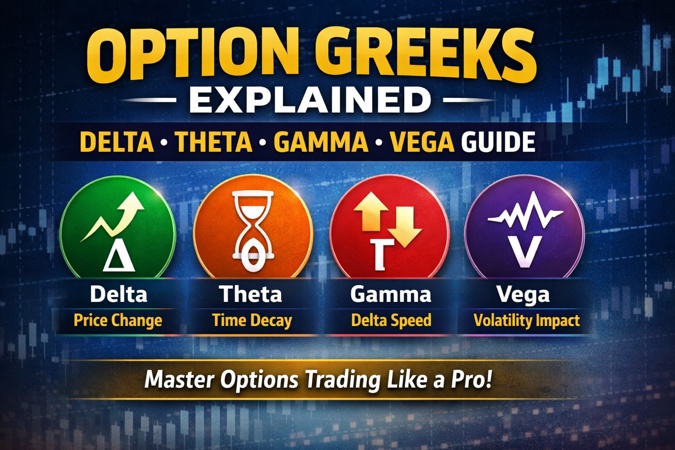
There are five Option Greeks, but beginners should focus on the four most important ones:
-
Delta - Measures how the option price changes with the underlying asset's price.
-
Theta - Represents time decay, how much value of an option loses over time.
-
Gamma - Measures how quickly Delta changes as the price moves.
-
Vega - Measures sensitive to changes in implied volatility.
Additional Greek (Least important for retail traders):
- Rho - Measures how the option price is affected by changes in interest rates.
Greeks are not tools for making predictions. They are instruments for behavior; they show you how your choice will act in certain situations, not where the market will go.
Delta - How Price Affects You
Delta in options trading is the amount that the option premium changes for every 1-point move in the underlying asset.
In simple words, Delta indicates the extent to which the price of your option reflects the stock's movement.
Delta by Option Type:
-
ATM (At-The-Money): Delta ≈ 0.5
-
ITM (In-The-Money): Delta approaches 1
-
OTM (Out-of-The-Money): Delta approaches 0
-
Call Options: Delta ranges from 0 to 1
-
Put Options: Delta ranges from 0 to −1
What Delta Really Means?
Delta represents participation.
If Delta is 0.4, your option captures 40% of the stock's movement.
Example:
Suppose you buy a call option of an ABC Company with a Delta of 0.4.
Stock Price moves up by ₹50.
Your option premium increases by ₹20.
Why? Because, your option captured 40% of the move (0.4 x 50 = 20).
Same way, it will work for a put option but in reverse. If a put option has a Delta of -0.4 and the stock price falls by ₹50, your option premium increases by ₹20 (-0.4 x -50 = +20).
Theta - Time Decay
Theta measures how much the premium of an option loses value every day as the time passes (assuming everything else stays the same).
In simple words, Theta is the daily rent you pay to hold an option.
How Theta Works
-
Theta is bad for option buyers; it hurts you every day.
-
Theta is good for option sellers since they make money as time goes on.
-
Theta decay starts slow but accelerates speed near expiry - meaning the closer you get, the faster your premium melts.
What Theta Really Means
Theta punishes you for waiting.
If the market doesn't move fast enough, your option will start losing value even if you are right about direction.
Example
Suppose you buy a ATM call option for ABC Company at ₹180, expiring in 10 days, with Theta = -10/day.
For the next 7 days the stock price doesn't move at all,
Your option loses ₹10 per day, so: 10 x 7 = ₹70
New value of an option: 180 - 70 = ₹110
Even though the stock doesn't move, you've lost almost 40% of your premium due to time decay (Theta).
Gamma - Rate of Change of Delta
Gamma measures how fast Delta changes for every 1-point move in the underlying asset.
In simple words, Delta is not static - Gamma decides how quickly you can speed up or down.
Key Points to Remember:
-
The Gamma of ATM options is the highest.
-
The Gamma for Deep ITM and Deep OTM options is low.
-
For ATM options, Gamma peaks as it approaches expiry.
Gamma Blast
Gamma explains why your option's premium can suddenly spike or drop faster than Delta alone predicts.
When the market moves sharply, Delta accelerates - your option gains faster.
When the market reverses, Delta decelerates - your option loses faster.
Example
Suppose you buy a call option for ABC Company,
Initial Delta: 0.2
If the stock price rises sharply,
Because of Gamma, Delta increases → 0.2 → 0.5 → 0.8
If the stock price reverses, Delta falls quickly in the same way and it can implify losses as well.
Vega - Volatility Sensitivity
Vega measures how much the option premium changes for a 1% change in implied volatility (IV).
Implied volatility reflects the market's expectations of future price swings.
Vega affects the premium even if the underlying asset's price doesn't move.
Key Points:
- ATM options - Highest Vega
- Deep ITM or OTM options - Lower Vega
- Increasing IV - Option premium rises which is good for option buyers
- Decreasing IV - Option premium falls which is good for option sellers
In simple words, Vega tells you that you can be right about the direction but still lose money if volatility drops.
Example
Suppose you buy a call option for ABC Company at ₹250 before quarterly results, the IV was high at that time:
Stock goes up slightly → good direction
Implied volatility (IV) falls after the announcement
Premium drops to ₹190
Even though the stock moved in your favor, Vega worked against you because you bought when IV was high. This situation is also called an IV Crash.
How Do Greeks Work Together?
Greeks never work alone. When a stock goes up, Delta raises your premium, but Theta lowers it every hour at the same time. If IV goes down after the incident, Vega pulls premiums down while Delta pushes them up. Gamma speeds up the whole interaction in a way that isn't straight.
This is why beginners are surprised by option chain analysis: the stock moved, but the option didn't change much. Several Greeks worked in different ways at the same time. If you know all four, there is no more confusion.
How Can Traders Use It?
-
Using Delta to choose a strike: ATM options with Delta 0.5 have about a 50% chance of concluding ITM. Options that are OTM with Delta 0.2 only have a 20% chance. Stay away from deep OTM options unless you think there will be a big, quick move at a certain time.
-
Using Theta to time your entry: Option buyers should enter when there is still time left. If you buy in the last 48 hours of the week, Theta will be working against you at its fastest speed from the first minute.
-
Before events, check Vega: IV goes up for no reason before earnings, RBI decisions, or budget announcements. When IV increases, buying implies spending too much. Even if the stock goes your way, a post-event IV fall can wipe out your premium.
Mistakes that Beginners Often Make
Buying deep OTM options because they seem inexpensive, without knowing that Delta is 0.1 and Theta is getting closer to expiration. Taking positions in the last two days of weekly expiration without taking Theta erosion into consideration. Buying high-Vega options soon before big events without realizing that IV crush after the event might wipe out any winnings right after.
Greeks for Risk Management
The most you can lose with options is the premium you paid.
Use this on purpose; never put more money into a single trade than you can afford to lose completely. Size positions based on the overall value of the lot, not the premium per unit.
Before you get in, know what kind of bet you are making. A high-Delta trade is a wager on a direction. A high-Vega trade is a wager on how volatile the market will be. Each one has its own dangers and needs to be managed in its own way.
Conclusion
If you understand option greeks, you can prevent the most common losses in trading. Delta, theta, gamma, and vega are not just ideas in options trading; they are the things that move your premium every minute the market is open.
Most newcomers lose in options not because they were mistaken about which way the market was going, but because they didn't know what was working against them while they waited. First, learn how to act. Strategy comes easily.
Responses (0)
Leave a Reply
Your email address will not be published. Required fields are marked *
You might also like

Multiple Time Frame Analysis: A Practical Swing Trading Framework
This swing trading strategy is designed for traders who struggle with timing, not ideas. Most losses don’t come from missing opportunities, but from acting during the wrong phase of the market. This framework uses multiple time frame analysis to separate planning, confirmation, and execution into distinct steps, removing emotional decision-making during live markets.
Top 3 Chart Patterns in Trading You Must Know as a Beginner
Are trading charts going over your head? Then look no further - This guide will break down the top essential chart patterns in trading, signal market movements, practical strategies, risk management, and common mistakes to avoid as a beginner.